How to Watch Every Christopher Nolan Film in Order (Updated for 2026)
How to Watch Every Christopher Nolan Film in Order (Updated for 2026)
Christopher Nolan has directed twelve films since 1998. With The Odyssey arriving in July 2026, his thirteenth, this is a good moment to figure out how to actually watch them — because "in order" turns out to be a genuinely contested question when your filmography includes a movie that runs backward and another with two timelines moving in opposite directions through the same scene.
I've written this guide for three kinds of people: the first-timer who wants to know where to start, the lapsed fan who saw The Dark Knight in 2008 and stopped paying attention, and the marathon-er who wants to do all twelve before The Odyssey drops. I'll tell you which order to watch them in, why each film matters, and where to find each one streaming right now.
Quick answer
The simplest recommendation: watch them in release order, starting with Memento (skip Following on your first pass — come back to it later). Release order tracks Nolan's growth as a filmmaker, so the rougher edges of his early work feel like a payoff rather than a tax. If you only have time for the essentials, watch these five in this order: Memento → The Prestige → The Dark Knight → Inception → Oppenheimer. That's roughly 12 hours and covers the full range of what he does.
The three viewing orders, briefly
People obsess over Nolan viewing orders the same way they argue about Star Wars or the MCU. There are basically three approaches.
Release order is the default, and it's what I recommend. You see Nolan figure out the puzzle-box thing in Memento, abandon it briefly for Insomnia, then weaponize it for everything that comes after. His craft visibly improves from film to film. By the time you get to Oppenheimer, you understand why he can pull off a 180-minute drama about physicists arguing in rooms.
Chronological by setting doesn't really work for Nolan because most of his films are set in a vague present, and the ones with specific time periods (Dunkirk, Oppenheimer, The Prestige) don't form a meaningful timeline. People try to do this. It's pointless.
The "best for newcomers" order is the one I'd actually recommend if someone has never seen a Nolan film and wants to be hooked fast: Inception → The Dark Knight → Interstellar → Memento → Oppenheimer → The Prestige → Dunkirk → Tenet → Batman Begins → The Dark Knight Rises → Insomnia → Following. This frontloads the crowd-pleasers, builds trust, then introduces the weirder structural experiments once you're invested.
For the rest of this guide I'm going through release order, which is the order I think most people should actually watch.
Every Christopher Nolan film, in release order
1. Following (1998) — 69 minutes
Shot on weekends over a year for about $6,000, Following is a black-and-white London thriller about a writer who shadows strangers for inspiration and finds one who's happy to be followed back. It's the first appearance of Nolan's structural obsession: the film is told out of order, and the way the timeline reassembles is the whole point.
Skip it on a first pass. Come back to it after you've seen at least five other Nolan films — you'll appreciate it as the prototype rather than a movie in its own right. It's also the shortest entry in his filmography by a wide margin, which means it's a low-cost reward when you finally get to it.
Check streaming availability →
2. Memento (2000) — 113 minutes
This is the one that made Nolan. Guy Pearce plays a man with anterograde amnesia hunting his wife's killer, with the entire film told in two interleaved sequences — one running forward, one running backward — that meet in the middle. The structure isn't a gimmick. It's how the protagonist experiences time, and it forces you to share his disorientation in a way no flashback ever could.
It still holds up. The screenplay was nominated for an Oscar. If you watch one early-Nolan film, watch this one.
Check streaming availability →
3. Insomnia (2002) — 118 minutes
Nolan's only directing job on a screenplay he didn't co-write, and his most conventional film by far. It's a remake of a Norwegian thriller, with Al Pacino as a sleep-deprived LA detective investigating a murder in an Alaskan town that never gets dark. Robin Williams plays the killer, against type and very well.
Insomnia is good. Not great. It exists mostly as proof that Nolan could direct A-listers and handle a studio job, which got him Batman Begins. Worth seeing for completionists, skippable for everyone else.
Check streaming availability →
4. Batman Begins (2005) — 140 minutes
The film that rebooted the entire idea of what a superhero movie could be. Before this, "comic book movie" meant either Spider-Man sincerity or Batman & Robin camp. Nolan's pitch — a Batman film treated like a crime drama, grounded in actual psychology, with a villain (Scarecrow / Cillian Murphy) who's terrifying instead of theatrical — set the template every comic book movie has either followed or pushed against for twenty years.
It's also the first appearance of Cillian Murphy in a Nolan film. Murphy will reappear in five more, eventually playing Robert Oppenheimer. Track the recurring cast and you'll find Nolan has a small repertory company he keeps reusing.
Check streaming availability →
5. The Prestige (2006) — 130 minutes
The most underrated Nolan film. I'll say that flat out. The Prestige is a film about two rival magicians (Hugh Jackman and Christian Bale) in late-Victorian London who slowly destroy each other in pursuit of the perfect illusion. It's also a film about filmmaking, which is why Nolan can't resist it — the magic-trick structure (the pledge, the turn, the prestige) is the same structure he uses to build a movie.
David Bowie plays Nikola Tesla. The film opens with Michael Caine explaining how illusions work, then performs every trick he just described on the audience. Watch it twice. The second time is better.
Check streaming availability →
6. The Dark Knight (2008) — 152 minutes
You've either seen this or you've heard so much about it that you know everything except the actual experience of watching it. Heath Ledger's Joker is the performance everyone remembers and the one that won him a posthumous Oscar, but the film around him is also a structural marvel — Nolan builds a three-act thriller where the Joker is essentially a chaos function that the heroes have to solve for, and each act tightens the screws further.
If you watch one Nolan film on the biggest screen you can find, make it this one. The IMAX-shot sequences (the opening bank heist, the truck flip on Lower Wacker Drive) were filmed on cameras that had basically never been used for narrative cinema before. The image quality is staggering even on a TV.
Check streaming availability →
7. Inception (2010) — 148 minutes
The film that turned Nolan into a brand. Inception is a heist movie set inside dreams inside dreams inside dreams, and the genius of it is that the rules are complicated enough to feel cerebral but simple enough that you can follow them. Time runs slower the deeper you go. The "kick" at the top wakes everyone in the layers below. Limbo is what happens if you die in a dream while sedated.
The ending — the spinning top, the cut to black — sparked maybe more dorm-room arguments than any movie scene of the 2010s. Nolan's official position is that he doesn't care if it falls. The film tells you what matters either way.
Check streaming availability →
8. The Dark Knight Rises (2012) — 165 minutes
The weakest of the Batman films, in my opinion, but still better than most superhero movies of its decade. Bane (Tom Hardy) is a great villain undercut slightly by a sound mix that made his dialogue famously hard to parse on first release. The plot involves a stock-exchange siege, a nuclear bomb, and Bruce Wayne climbing out of a pit while chanting in a language he doesn't speak.
If you're doing the full Nolan filmography, you watch this. If you're cherry-picking, skip it. The trilogy lands harder if you just rewatch The Dark Knight.
Check streaming availability →
9. Interstellar (2014) — 169 minutes
Nolan's most divisive film among his own fans. Some people think it's his masterpiece. Others think the third act collapses. I'm closer to the first camp, but I understand the second.
Interstellar is about a father (Matthew McConaughey) leaving Earth to find a habitable planet for humanity, on a ship powered by Kip Thorne's actual physics consulting. The black-hole sequence was so accurate it generated a peer-reviewed paper. The score (the last great Hans Zimmer Nolan collaboration before Ludwig Göransson took over) is the loudest, most emotional thing Zimmer ever wrote — the church organ in "No Time for Caution" is on a different planet from his usual brrraaaaammm.
The film's weak spot is a third act that explains itself when it doesn't need to. Watch it anyway. The first two hours are sublime.
Check streaming availability →
10. Dunkirk (2017) — 106 minutes
Nolan's shortest film since Following, his most experimental since Memento, and the one most people overlook when ranking his work. Dunkirk tells the story of the 1940 evacuation across three timelines running at different speeds: a week on the beach, a day at sea, and an hour in the air, all converging at the same moment. Hans Zimmer's score is built on the Shepard tone — a sound illusion that seems to be constantly rising — which is what gives the whole film its escalating tension.
There's almost no dialogue. The German enemy is barely seen. It's closer to silent cinema than to The Dark Knight, and it's astonishing.
Check streaming availability →
11. Tenet (2020) — 150 minutes
This is the one that doesn't quite work, and I'd rather say that than pretend otherwise. Tenet is about a CIA agent (John David Washington) trying to prevent a future war using "inverted" entropy — objects and people moving backward through time. The set pieces are extraordinary. The car chase in Tallinn, where half the vehicles are reversing through traffic that's moving normally, is one of the great action sequences of the last decade.
The problem is the dialogue. A lot of plot is communicated in scenes where two people stand in a corner and explain inversion to each other, often through breathing masks, often barely audibly. The film expects you to either accept that you won't follow everything or watch it twice. Most people do neither, and Tenet gets a worse reputation than it deserves.
Watch it. It's better than its reputation. Just don't make it the first Nolan film you show someone.
Check streaming availability →
12. Oppenheimer (2023) — 180 minutes
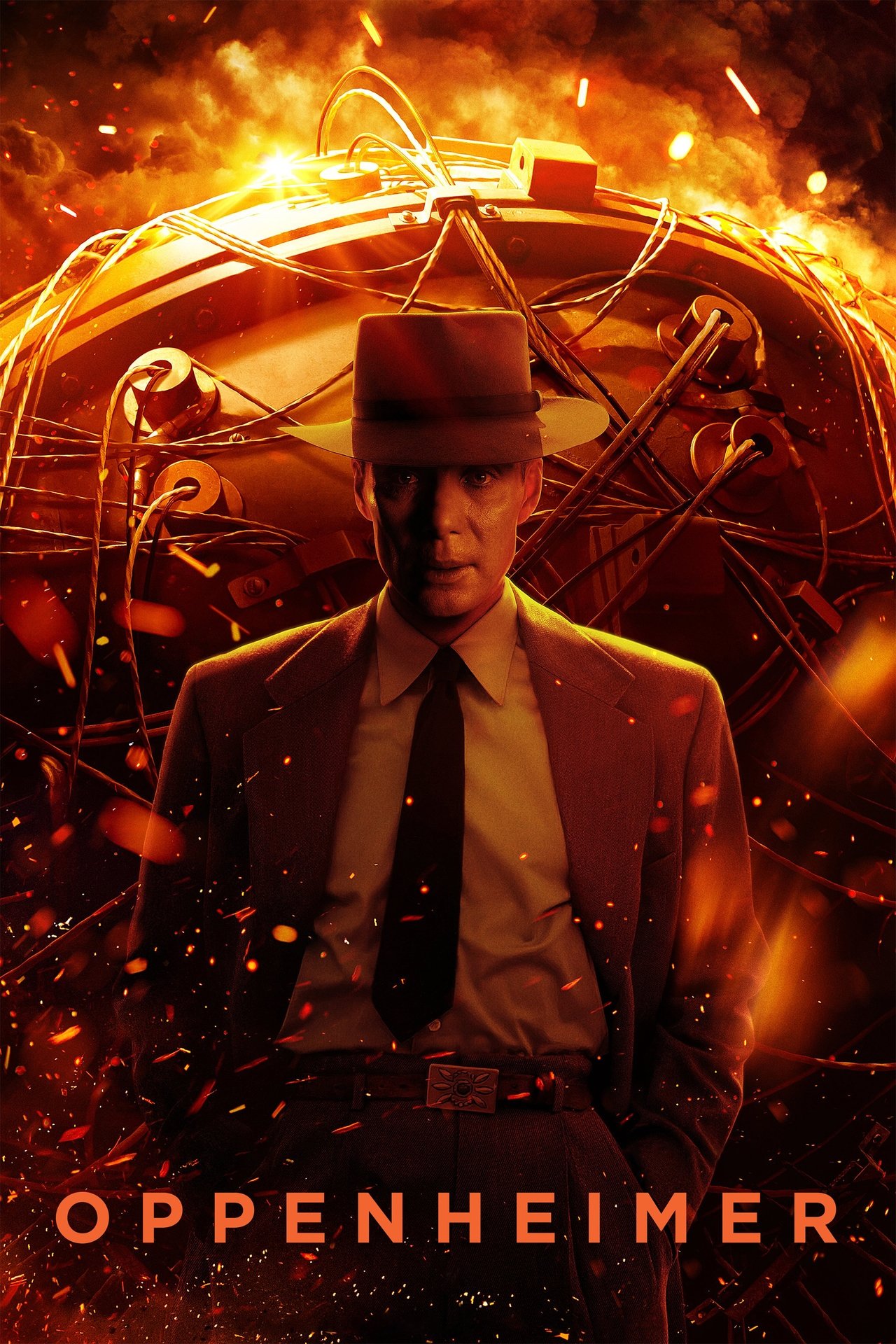
His most awarded film. Seven Oscars including Best Picture, Best Director, and Best Actor for Cillian Murphy, who Nolan first cast twenty years earlier in Batman Begins. Oppenheimer is a three-hour film about a theoretical physicist who builds the bomb and then spends the rest of his life regretting it, structured as two interlocking inquiries — one in color, one in black and white — that resolve into a single tragedy.
It also made over a billion dollars at the box office. A three-hour, R-rated, dialogue-driven biopic about Cold War security clearance hearings. Hollywood spent fifteen years insisting nothing like this could work commercially. Nolan made it work.
Check streaming availability →
What's coming next: The Odyssey (July 2026)
Nolan's thirteenth film is an adaptation of Homer's Odyssey, with Matt Damon as Odysseus and a cast that includes Tom Holland, Zendaya, Anne Hathaway, Robert Pattinson, Charlize Theron, and (inevitably) Cillian Murphy. Filming wrapped in late 2025 across Greece, Italy, Morocco, and Iceland. Universal is releasing it on July 17, 2026.
Whether it'll be his thirteenth great film or his second misfire is the question. Either way, it's the one Nolan film you can plan to see on the biggest screen possible the week it opens — he has confirmed it'll be shot mostly in IMAX 70mm.
What makes a Christopher Nolan film a Nolan film
If you've watched more than three of his movies, you've noticed the patterns. They're not coincidences. Nolan is one of the most stylistically consistent directors working, and once you can see his fingerprints you can't unsee them.
He shoots on film, often IMAX 70mm. Almost no other working director uses the format at this scale. He's a vocal opponent of digital cinematography and a key reason IMAX 70mm projection still exists in commercial theaters.
He hates green screen. When he can build it for real, he builds it for real. The truck flip in The Dark Knight is a real truck flipping. The 747 crash in Tenet is a real (decommissioned) 747. The Stargate hallway in Inception is a 100-foot rotating set.
He works with a small repertory company. Michael Caine has been in every Nolan film since Batman Begins until his retirement. Cillian Murphy has been in six. Christian Bale, Tom Hardy, Anne Hathaway, Joseph Gordon-Levitt, and Marion Cotillard return across multiple films.
He almost always co-writes with his brother Jonathan. Jonathan Nolan also created HBO's Westworld and Amazon's Fallout. The exceptions: Following and Inception (Christopher solo), Insomnia (David Kahn).
Hans Zimmer was the sound of Nolan until 2020. Zimmer scored every Nolan film from Batman Begins through Dunkirk. Tenet and Oppenheimer are Ludwig Göransson. The Odyssey will be Göransson too.
Time is the obsession. Every Nolan film is about time in some form — how memory distorts it (Memento), how dreams stretch it (Inception), how relativity bends it (Interstellar), how war collapses it (Dunkirk), how it runs backward (Tenet), how history weighs on the moment of decision (Oppenheimer). If you wanted to summarize his entire filmography in one word, that's the word.
Tips for a Christopher Nolan marathon
If you're doing the full filmography in a weekend, a few things help.
Watch on the biggest screen you have access to. Many of Nolan's films were composed for IMAX, which means the framing on a phone is a different movie than the framing on a 65-inch TV. If you have a friend with a projector, this is the time to ask.
Subtitles on. Nolan's sound design is famous for being deliberately murky. Interstellar and Tenet both got news coverage at release for dialogue that audiences couldn't parse. Subtitles aren't a concession; they're how you actually catch what's being said.
Pace yourself. The full filmography (including Following) is about 25 hours. Twelve films in two days is doable but exhausting. Twelve films in a week is the better experience.
End on Oppenheimer. If you're watching in release order anyway, this is the natural conclusion, and it's the film that benefits most from having the rest of his career as context. The way Nolan stages the Trinity test sequence is something you appreciate more after you've seen what Dunkirk and Interstellar did with sound and silence.
Frequently asked questions
What is the best order to watch Christopher Nolan's films?
Release order, starting with Memento. This lets you see Nolan's craft develop chronologically, and the puzzle-box films feel more rewarding once you trust the filmmaker.
Which Christopher Nolan film should I watch first?
For most people, Inception (2010) or The Dark Knight (2008). Both are accessible, both are excellent, and both demonstrate Nolan's strengths without demanding too much structural patience.
How many films has Christopher Nolan directed?
Twelve theatrical features as of 2026: Following, Memento, Insomnia, Batman Begins, The Prestige, The Dark Knight, Inception, The Dark Knight Rises, Interstellar, Dunkirk, Tenet, and Oppenheimer. The Odyssey releases July 17, 2026, as his thirteenth.
What is Christopher Nolan's highest-rated film?
By critical consensus, The Dark Knight and Oppenheimer are tied at the top, both with extraordinary critical reception and Oscar recognition. Memento and Inception are close behind.
What is Christopher Nolan's longest film?
Oppenheimer at 180 minutes (3 hours). Interstellar (169 min) and The Dark Knight Rises (165 min) are the next-longest.
Does watching the Dark Knight trilogy require seeing other Nolan films first?
No. The Dark Knight trilogy is self-contained. Batman Begins → The Dark Knight → The Dark Knight Rises works as a stand-alone trilogy and is a common entry point.
Are all Christopher Nolan films connected?
No. Most of his films are stand-alone. Only the Dark Knight trilogy shares characters and continuity. The rest are connected only by themes, recurring collaborators, and Nolan's stylistic signatures.
Where can I stream Christopher Nolan films?
Availability shifts constantly. Oppenheimer and most of his Universal/Warner Bros. titles rotate between Peacock, Max, and Netflix depending on the country and the licensing window. For real-time, country-specific streaming options, use the search at the top of wheretowatch.me.
If this guide was useful, you might also like our breakdowns of where to watch the Dark Knight trilogy and every A24 film and where to stream them. For real-time availability on any Nolan film, search the title on our homepage.
Related reading
Want to know where to watch any movie or show?
One search, every streaming service in your country.